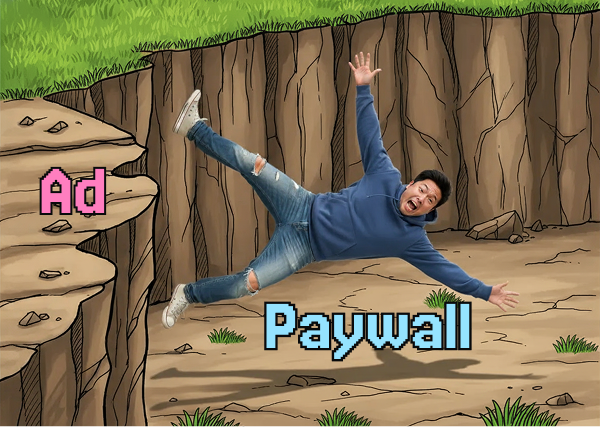



Most growth teams understand ad fatigue instinctively. When a customer sees the same ad too often, performance drops and they tune out. The same dynamic is playing out further down the funnel at the moment of conversion. This is paywall fatigue.
When a customer sees the same ad too often performance drops and they tune out. CPMs rise while returns fall. Social media platforms even bake this into their ad tooling through metrics like frequency (Meta) and fatigue (Tik Tok).
The same dynamic is playing out further down the funnel at the moment of conversion.
What is Paywall Fatigue?
Just as ad fatigue occurs when repeated exposure causes ads to lose effectiveness, paywall fatigue occurs when users are repeatedly exposed to the same paywall experiences, leading to disengagement, erosion of trust, and declining monetization performance.
The critical difference between ad fatigue and paywall fatigue, beyond their placement at opposite ends of the funnel, is visibility. Most growth teams actively monitor ad fatigue, but very few are watching for paywall fatigue.
This is not the same as price sensitivity or subscription fatigue. Users are still willing to pay for value. They’re just increasingly resistant to how that value is being presented.
"
Paywall fatigue is an experience problem, not a pricing one.
"
Paywall Fatigue is Accelerating
Several market forces are converging at once.
Subscription saturation
Users now manage dozens of subscriptions across media, fitness, productivity, finance, and entertainment. They are more discerning, more skeptical, and faster to abandon experiences that feel extractive.
Growth pressure
Teams are under constant pressure to:
- Put the paywall in front of users sooner
- Get more eyes on the paywall
- Convert at all costs
These tactics often backfire, especially at scale.
One-size-fits-all monetization
Many apps still rely on the same static paywall shown to every user, in every context, with the same message. Some may even leverage A/B tests or utilize a handful of personalized paywalls, but the paywalls themselves remain relatively static.
Tooling that optimizes the wrong outcome
Monetization tools make it easy to test layouts and prices, but what about user intent, lifecycle stage, or downstream impact like churn and reactivation?
Amplification at scale
With larger user bases, small monetization inefficiencies compound quickly. What looks like a minor conversion dip in isolation can become a material revenue and retention risk when the same paywall experience is repeated at scale.
| Ad fatigue | Paywall fatigue | |
|---|---|---|
| Definition | Diminishing effectiveness caused by repeated exposure to the same ad | Diminishing effectiveness caused by repeated exposure to the same paywall |
| Primary surface | Social feeds, banners, pre-roll, native units | In-product experiences (web, mobile, CTV, console) |
| Funnel position | Top of funnel | Bottom of funnel |
| User reactions | Scrolling past, tuning out / banner blindness, installing an ad blocker | Instant closes, feature avoidance, app uninstall or abandonment |
| Early warning signs | Falling CTR, rising CPC / CPM | Falling conversion lift, faster dismissals, shorter time to churn |
What Paywall Fatigue Looks Like
Common symptoms of Paywall fatigue include:
- Users closing the app immediately after a paywall appears
- “High-converting” paywalls followed by unusually fast churn
- Declining engagement before the paywall moment
- Users learning to avoid features they associate with monetization
- Teams running more tests but learning less from them
When this happens, adding more variants, more triggers, and more urgency only compounds the issue. Just like ad marketers have learned to treat ad fatigue as a valuable early warning signal, growth teams must listen to paywall fatigue and take appropriate action.
Common Causes of Paywall Fatigue
Across high-volume consumer apps, a few patterns show up repeatedly.
Showing the paywall before value is clear
If a user hasn’t experienced meaningful value, a paywall feels like friction, not an opportunity. Early exposure can work, but only when value is implied or already demonstrated.
Repeating the same message everywhere
Seeing the same headline, same benefits, and same design across onboarding, feature access, and re-engagement trains users to ignore it.
Ignoring context and intent
A user who just completed a meaningful action is in a very different mindset than a user who just opened the app for the first time. Treating them the same leads to fatigue.
Optimizing for conversion rate alone
A paywall that converts well but produces short-lived subscribers is often labeled a “winner.” In reality, it’s borrowing revenue from the future.
Treating paywalls as screens, not systems
When paywalls are static moments instead of part of a broader monetization journey, teams lose the ability to adapt over time.
How to measure paywall fatigue
If you’re familiar with ad fatigue, paywall fatigue is measured the same way: by tracking frequency.
Frequency = Impressions ÷ Reach
In advertising, when frequency increases and performance declines, fatigue is setting in. The same pattern applies to paywalls.
While most teams track paywall views in aggregate, fewer look at exposure per user, which is where fatigue shows up first. That’s why it’s important to monitor both frequency and performance together to understand when paywall exposure stops helping and starts hurting.
Early warning signals of paywall fatigue:
- Rising paywall frequency paired with flat or declining conversion
- Faster dismissals after repeated exposures
- Shorter time from conversion to churn among high-exposure users
The goal isn’t to minimize paywall exposure. It’s to understand when additional exposure stops adding value and starts causing damage.
Just as ad teams use frequency caps and creative rotation, mature monetization teams use paywall frequency to inform timing, variation, and refresh cycles.
Paywall fatigue appears as diminishing returns
The relationship between paywall frequency and performance mirrors what ad teams have seen for years. As exposure increases, conversion does not collapse immediately. Instead, it tapers off over time, a classic sign of fatigue.
The chart below illustrates this pattern, with paywall fatigue beginning around the dotted threshold line. While fatigue isn’t a single moment, it marks the tipping point where additional exposure starts producing diminishing returns.
Identifying the fatigue threshold
While the curve shows the pattern, you can look at the data to see where fatigue begins to set in.
By looking at conversion rate alongside frequency, you can identify the point where each additional paywall exposure results in a disproportionate decline in performance. In this example, performance begins to meaningfully degrade once frequency exceeds ~2 exposures per user. At that point, CTR drops sharply, with the marginal decline accelerating from roughly -0.11 to -0.40 per additional exposure.
Beyond this point, showing a user the same paywall no longer pays for itself.
| Paywall frequency | CTR | Δ CTR vs prior |
|---|---|---|
| 1.1 | 2.40% | — |
| 1.5 | 2.31% | -0.09% |
| 1.8 | 2.20% | -0.11% |
| 2.5 | 1.80% | -0.40% |
| 3.2 | 1.20% | -0.60% |
| 4.0 | 0.70% | -0.50% |
Paywall fatigue begins when additional exposure stops adding value. It is important to refresh the experience for users before fatigue sets in.
Paywall Monetization Maturity
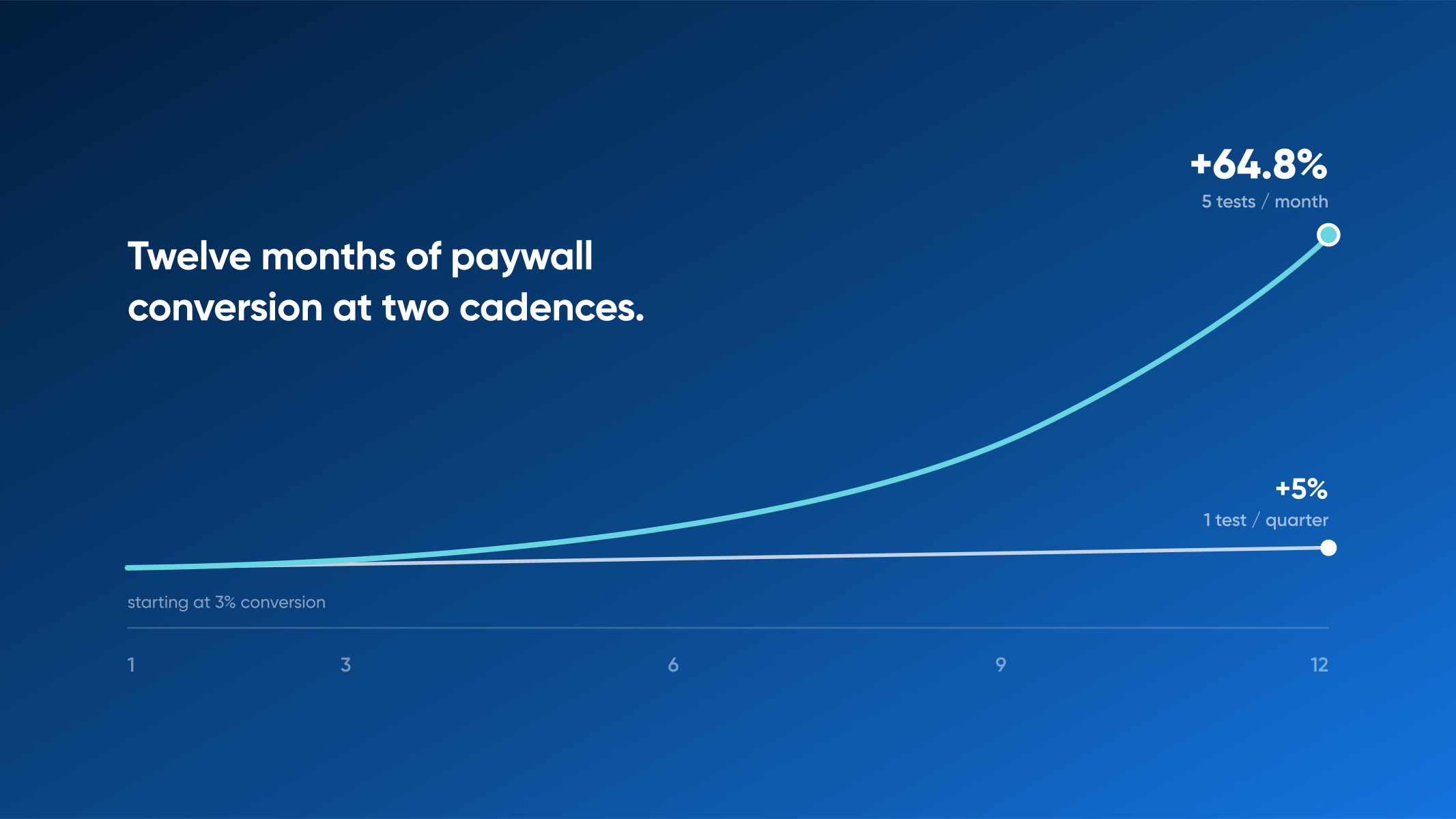
As monetization matures, teams move from shipping a single paywall to operating a portfolio of paywall experiences, refreshed with the same rigor as ad campaigns. Operating that portfolio at speed means closing the experiment velocity gap — the lag between a variant idea and a live test.
| Immature | Maturing | Mature monetization | |
|---|---|---|---|
| Paywall strategy | One primary paywall used everywhere | A small set of paywalls mapped to key flows | A system of paywall experiences tailored to user behavior and lifecycle stage |
| Creative & messaging | Static copy and design shipped once | Occasional updates based on performance | Continuously refreshed creative and messaging like ad campaigns |
| Triggering | Aggressive early triggers | More thoughtful, rule-based placement | Context-aware triggers aligned to moments of value |
How leading teams keep paywalls fresh and reduce paywall fatigue
The teams seeing sustained subscription growth tend to follow a few core principles.
Align paywalls with moments of value
Paywalls perform best when they appear immediately after a user experiences something meaningful. This reinforces cause and effect rather than interruption.
Personalize by behavior, not demographics
Usage patterns, feature engagement, and intent signals are far more predictive than user attributes. Context-aware paywalls feel relevant instead of repetitive.
Rotate messaging and value framing
Different users care about different outcomes. Even the same user may care about different outcomes over time. Messaging should evolve accordingly.
Use progressive monetization
Instead of hard stops everywhere, allow users to build momentum before escalating. This reduces friction while preserving revenue potential.
Measure downstream impact
Track churn, retention, and expansion alongside conversion. A slightly lower conversion rate with materially higher LTV is often the better outcome.
Lessons from digital advertising
The teams that survived the ad era learned a hard truth: more exposure does not equal more revenue. They invested in frequency control, creative rotation, relevance, and timing.
The future of monetization belongs to teams who treat paywalls at the bottom of the funnel as adaptive systems, not static screens. Paywalls, just as other experiences, should be refreshed
And just like with ads, the teams who learn when to show less will ultimately earn more.