Most subscription businesses don't have a subscriber journey. They have a paywall.
A landing page, a paywall, a thank-you screen. That's what most teams call the journey. The experience layer needs an orchestrated runtime that reads who the subscriber is, where they came from, and what would make sense to show them next.
For most subscription businesses, the “subscriber journey” is a static landing page, a static paywall, and a thank-you screen. There's no orchestrated logic in between that routes a first-time visitor differently from a returning lapsed subscriber, or a Spanish-language acquisition differently from an English-language one. What looks like a journey is three disconnected pages that don't read context, don't branch, and don't respond to who's on the screen.
When a team does have a flow, it's usually one flow. Every subscriber — regardless of acquisition source, language, region, prior session count, or intent signal from the form they just filled out — walks the same path to the same paywall. The CDP knows the subscriber. The campaign that brought them in knows the subscriber. The flow knows nothing.
The bottleneck on fixing this isn't taste or data. It's that every change to the journey today is a code change, a regression test, and an App Store review queue. Marketing has ideas. Product has data. Growth has variants ready. None of it ships, because the journey is built in code that nobody wants to touch.
In practice
Compose, branch, and ship the full subscriber journey.
Step paletteDrag any step onto the canvas. Connect with a click.
Landing
Paywall
Plan picker
Offer
Upgrade
Confirm
Entry
Platform
iOS · Welcome
CTV · Hero
Trial
Convert
ConditionsOne flow definition. Dozens of routed variants.
TypeConditionRoute to
Platformis iOS→ Welcome (iOS)
Platformis in CTV group→ Hero paywall
Regioncountry in DE, FR, ES→ EU plan picker
Segmentis lapsed subscriber→ Win-back · 30% off
Audiencein CDP — high-intent→ Annual offer
Inside the appTriggers fire from the screens subscribers actually see — taps, sign-ins, and purchases advance the journey.
iOS · Welcome
Welcome
Watch every match, ad-free
Annual · $79.99
Start 7-day trial
Web · Plan picker
Pick your plan
Monthly
$9.99/mo
Annual
$79.99/yr · save 33%
Apple TV · Hero
Hero paywall
Unlock the full library
Start trialSign in
“Start trial” tap on Apple TV advances to the next step in the same flow.
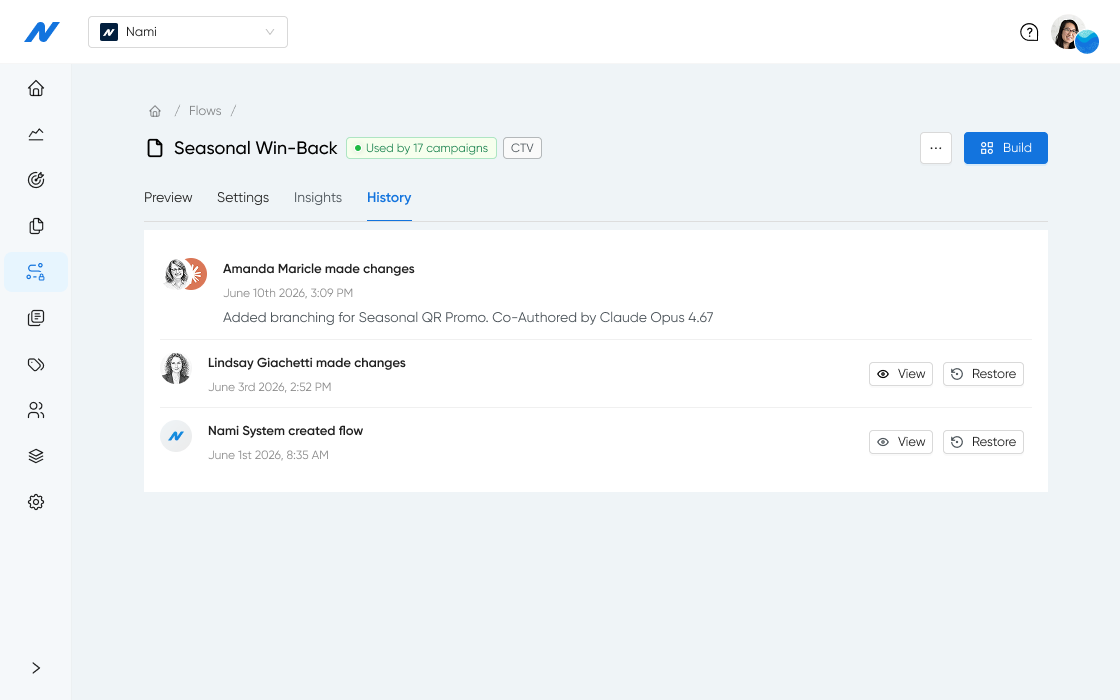
Version historyEvery change is a publish. Every publish is reversible.
10:42LindsayPublished v15 — added Win-back branch for lapsed > 30dLive
09:18MateoEdited offer copy on Welcome (iOS)Saved
YesterdayPriyaAdded EU plan picker · region = DE, FR, ESLive
MonLindsayRolled v12 → v11 (regression on annual price in CA)Rollback
Last wkMateoCloned 'Onboarding · Q2' → 'Onboarding · CTV-only'Draft
Version history
Every flow change is logged. Every previous version is one click away.
When a marketer ships a flow update, the team can see exactly what changed, when, and roll back without engineering.
One flow. Every screen subscribers actually use.
A flow built once in Nami runs across CTV, web, and mobile from one dashboard. Layouts adapt to the device, and so does the logic. Branch a path so TV viewers see a QR handoff while mobile subscribers get a native prompt, all inside the same flow. Focus behavior on a remote, native scroll on mobile, and platform commerce hooks are handled in the canvas.
The same upgrade flow that runs on mobile runs on a streaming box without a separate build, a separate team, or a separate roadmap. CTV stops being the surface that gets last quarter's experience six quarters late.
Frequency is the lift.
When a subscriber journey is something a small team can update in an afternoon, it stops being a fixed asset. It becomes a working surface that gets sharper every quarter — segment by segment, platform by platform, offer by offer. The compounding comes from frequency: more variants tested, more learnings logged, more pricing in market. Enterprise subscription businesses who went from a single paywall to personalized onboarding with Nami saw millions in increased revenue.
Flows are one piece of subscription orchestration.
Subscription flows are the orchestrated runtime inside Nami's subscription orchestration platform. Product and marketing teams use them to design, test, and optimize the complete subscriber journey across CTV, web, and mobile, without code. The pages inside each flow are composed in the visual editor. Variants of a flow run head-to-head in Experiments with adaptive traffic allocation. Campaigns assign flows to specific trigger points in the app, with audience targeting and scheduling. Insights closes the loop, connecting what subscribers saw to what they did next.
You are here
Flows
The orchestrated runtime for the subscriber journey.
What's the difference between subscription flows in Nami and a generic funnel builder?
Generic funnel builders were designed for lead capture and landing pages, not for subscriptions. They don't model paywalls, trial offers, plan selectors, regional pricing, or platform-specific behavior. Subscription flows in Nami are built around those primitives — the canvas understands what a paywall is, what an entitlement is, what a CTV remote does — and the same flow definition ships to CTV, web, and mobile from one no-code dashboard. The unit of work is a subscriber journey, not a generic funnel.
Do we still need engineering to update flows?
For day-to-day flow work, no. Once your engineering team completes the initial SDK integration, a one-time setup, product and marketing teams add steps, change branches, and update offers without filing a ticket or cutting a release. Engineering owns the SDK and the backend logic for auth, entitlements, and billing. Product and marketing own the journey.
Can a single flow run different paths on different platforms or segments?
Yes. Conditional logic routes subscribers by platform (iOS, Android, web, and every major CTV surface), subscriber state (visitor, trialist, active, lapsed), country, language, GeoIP, or CDP audience. One flow definition can produce dozens of variants without duplicating the canvas, and the team reads results on one set of subscription-aware metrics rather than reconciling three.
Where does Flows fit alongside our paywall tool?
Most paywall tools cover one screen, on one or two platforms. Flows cover the journey around it — landing pages, onboarding, plan selectors, upgrade prompts, win-back sequences — across CTV, web, and mobile. Subscription orchestration is the practice of designing, testing, and optimizing the complete subscriber journey from first impression to first payment and beyond, from one system, without code. A paywall is one step in that journey. Teams using Flows typically retire their paywall-only tool during onboarding.
Can we test a new flow against the current one?
Yes. Variants of a flow run head-to-head in Experiments with adaptive traffic allocation: a new onboarding sequence against the existing one, an alternate upgrade path against today's, a regional offer against the global default. Results are subscription-aware, so the team declares a winner on the metric that actually matters — trial starts, paywall conversion rate, revenue per subscriber.
The flow before the paywall is where growth lives
Strong landing flows nurture intent before a price ever appears; well-paced onboarding flows show value before the upsell. The teams winning in 2026 are pacing the journey, not stacking paywall screens.
Book a demo and we'll walk through how product and marketing teams compose, branch, and ship full subscriber journeys on Nami — across CTV, web, and mobile, without an engineering ticket.