Design every subscription page without an engineering ticket.
Pages are the screens inside every subscriber journey — paywalls, onboarding, plan selectors, upgrade prompts, win-back offers. Product and marketing teams compose them in Nami Designer and publish across CTV, web, and mobile from one canvas. No release cycle. No separate build per platform.
Start your 7-day free trial. Cancel anytime, on any device.
Monthly
$9.99/mo
Annual
$79/yr
Save 33%
Family
$129/yr
Up to 6
100%·CTV
Time to publish
Hours, not sprints
You don't have a paywall problem. You have a sprint problem.
Most subscription teams know exactly what they want to test on the paywall, the upgrade screen, the onboarding sequence. The hold-up isn't taste. It isn't data. It's that every creative decision waits behind feature work, release calendars, and the App Store queue. A five-minute change ships in six weeks. Product owns the experience. Engineering owns the keyboard.
That's one platform. Most subscription businesses now run on at least two of CTV, web, and mobile, each with its own SDK, design system, and release cadence. The paywall on iOS doesn't match the paywall on Roku. The Apple TV experience trails mobile by two years. Three engineering teams ship three slightly different versions of what should be one screen.
Paywall-only tools fix the conversion screen and leave the rest of the journey where it was: the landing page, the onboarding sequence, the plan selector, the upgrade prompt, the win-back offer. What product and marketing need is broader. A way to design every page subscribers see, across every device they use, that the rest of the business can change without waiting on a release.
What Pages cover
Every screen subscribers see, on one canvas.
01
Every page on the subscriber path, in one place
Paywalls, onboarding screens, plan selectors, upgrade prompts, account screens, win-back offers — every page subscribers see is composed in the same canvas, with real-time preview across phone, tablet, web, and CTV. No code, no engineering ticket, no separate editor per surface. The editor that powers this is Nami Designer.
PaywallsOnboardingPlan selectors
02
Components for the parts that repeat across pages
Buttons, hero blocks, legal copy, plan cards, calls to action — the moving parts inside every page are Components. Build one and reuse it across hundreds of pages. Change a brand color, a price chip, or a headline once, publish, and every page that references it updates. Brand consistency stops being a project and becomes a publish.
ComponentsTokensBulk publish
03
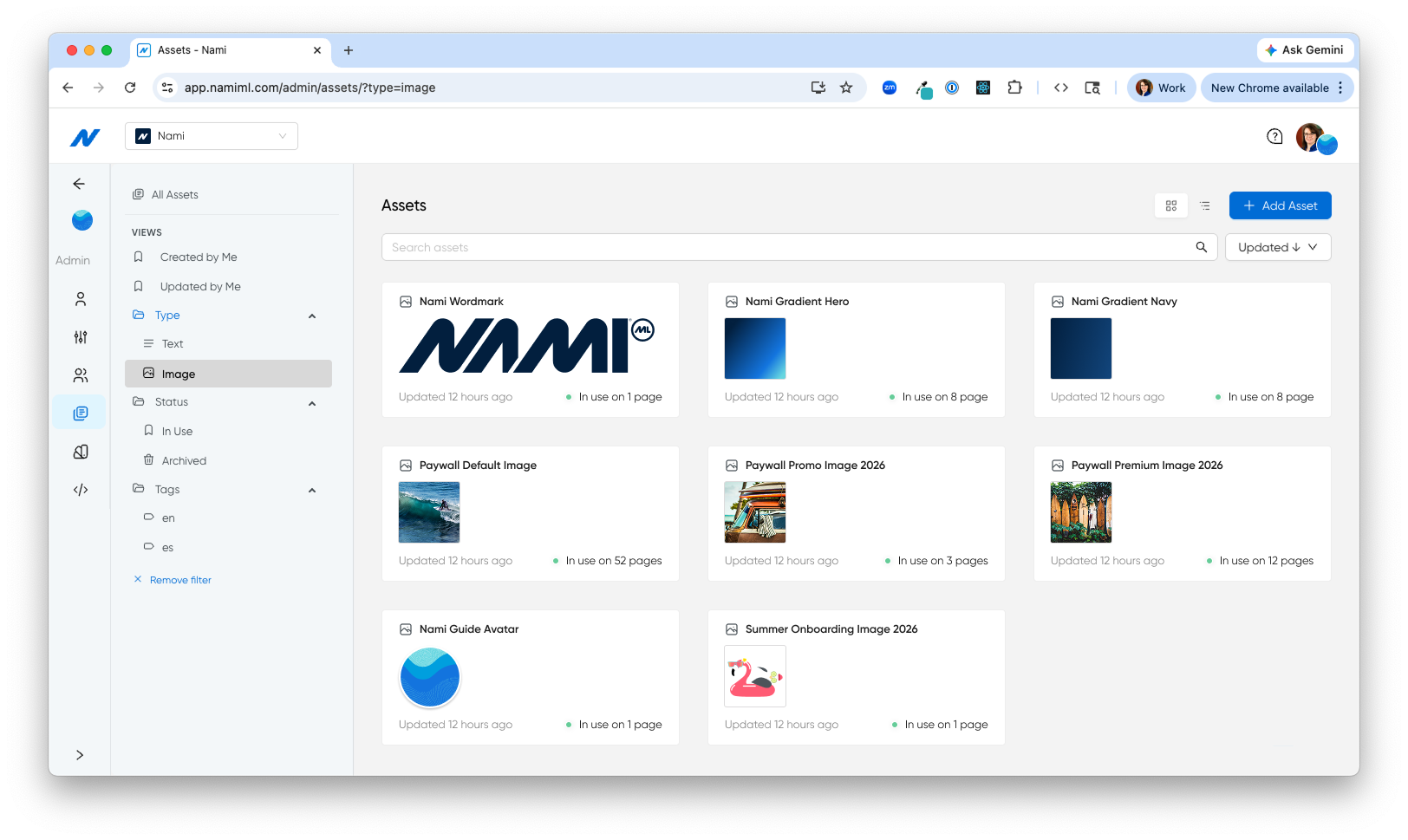
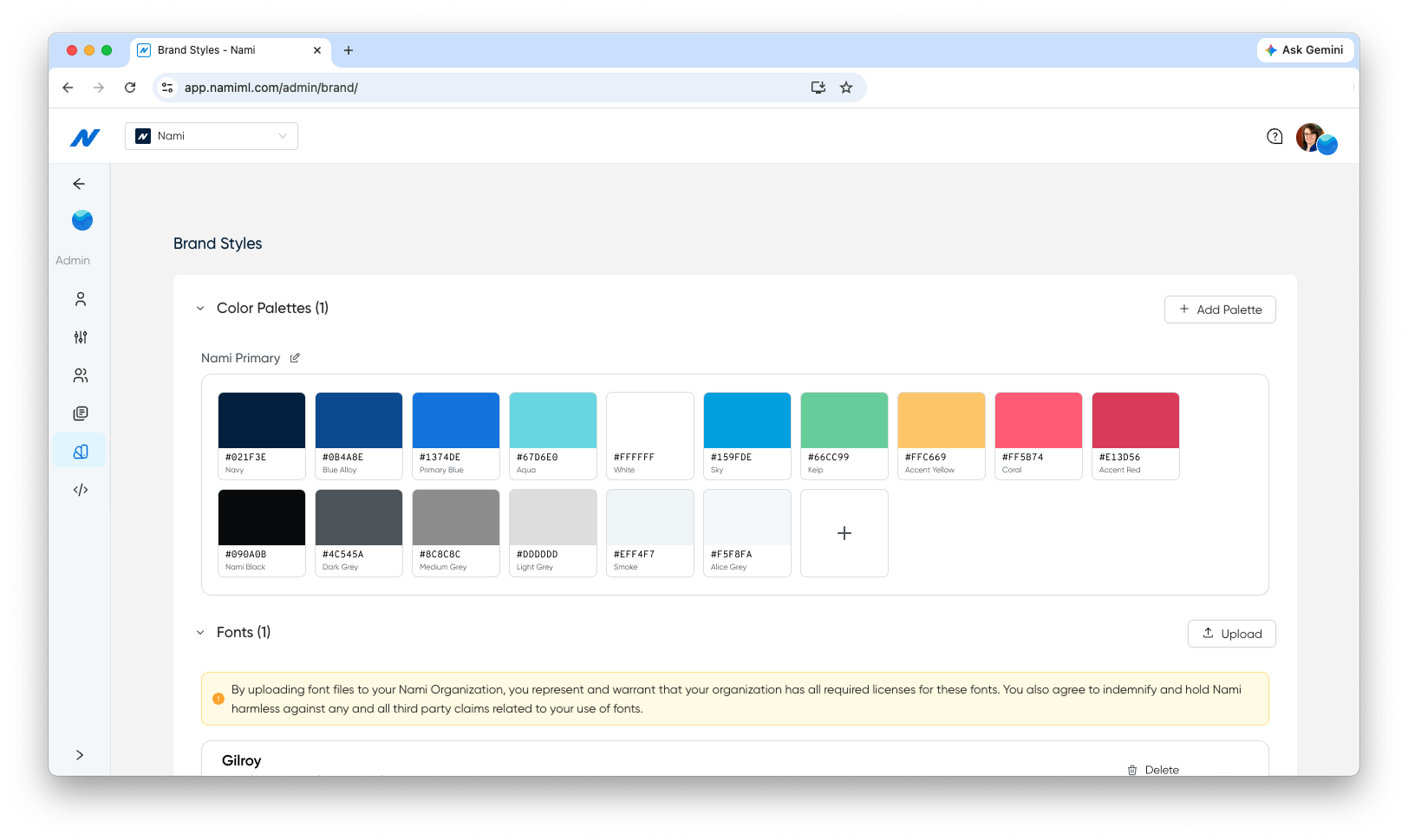
Brand assets that propagate on one publish
Colors, fonts, copy strings, imagery, and localized variants live in a shared Asset Library, versioned with a full changelog. Update a token or a string once and every page picks up the new version on the next publish. Hundreds of pages stay coherent without anyone touching them individually.
Asset LibraryVersioningLocalization
04
One definition, every device subscribers use
The same page renders correctly on iOS, on Apple TV, on the web, on Roku. Focus behavior for remotes, native scroll on mobile, and platform commerce hooks are handled in the canvas, not separately per surface. One page, one definition, every device.
Phone · Tablet · Web · CTV
Every brand asset in one library — searchable, taggable, reusable across pages.
One brand system — colors, fonts, logos — applies to every page your team publishes.
One canvas. Every platform subscribers use.
Most paywall builders top out at iOS and Android. Pages ship from one canvas to every surface subscribers use — CTV, web, and mobile. CTV is a first-class citizen, not an afterthought.
The same page renders correctly on a phone in your hand and a Roku across the room, with platform-specific layouts and focus behavior handled in the canvas instead of by an engineering team.
One source · 13 destinations
iOS
Android
Apple TV
Roku
Fire TV
LG
Samsung
Vizio
Xbox
Google TV
Chrome
Safari
Edge
The lift compounds when you ship more.
Every paywall change you don't ship is a test you don't run. Every test you don't run is a learning that doesn't compound. Teams using Pages ship more variants, more often, on more surfaces. The experience layer gets sharper every quarter, and the subscribers who arrive next quarter see a paywall built on what the team learned this one.
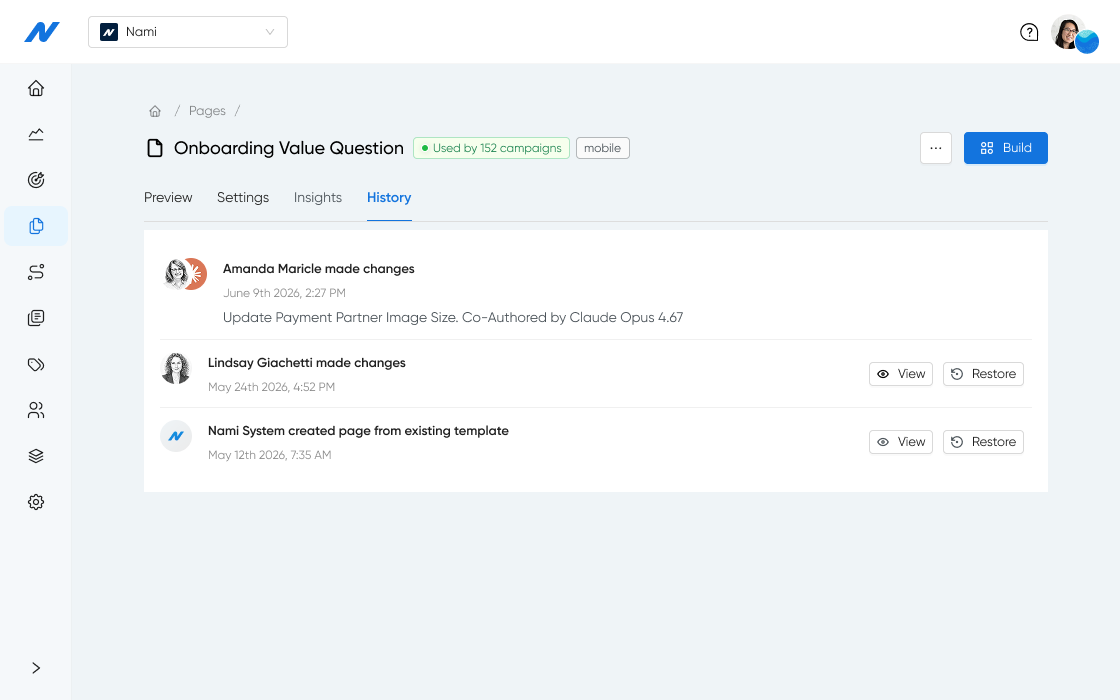
A page-by-page audit log of who changed what, when — roll back to any prior version without filing a ticket.
Pages are one piece of subscription orchestration.
The pages you build live inside Nami's subscription orchestration platform — the system product and marketing teams use to design, test, and optimize the complete subscriber journey across CTV, web, and mobile.
You're here
Pages
The composable surfaces inside every subscriber journey — paywalls, onboarding, plan selectors, upgrade prompts, win-back offers.
For day-to-day page work, no. Once your engineering team completes the initial SDK integration, a one-time setup, product and marketing teams design, publish, and update pages without filing a ticket or cutting a release. New paywalls, onboarding screens, and upgrade flows ship the same day they're designed. Engineering owns the SDK and the backend logic for auth, entitlements, and billing.
How do Pages handle connected TV?
CTV is built into the canvas, not bolted on. The same canvas creates pages for Apple TV, Roku, Fire TV, LG, Samsung, Vizio, Xbox, and Google TV, with platform-specific focus behavior, remote navigation, and layout adjustments handled automatically. You design once and the page renders correctly on each surface, without a separate CTV build or a separate CTV team.
Can we keep brand consistency across hundreds of pages?
Yes. Brand colors, fonts, copy strings, imagery, and reusable components live in a shared Asset Library. Update a token or a component once and every page that references it updates on the next publish. Subscription orchestration — the practice of designing, testing, and optimizing the complete subscriber journey across every platform from one system, without code — only works when brand consistency is a publish, not a project.
Does Pages replace our existing paywall builder?
In most cases, yes, and it covers more than a paywall builder does. A typical paywall builder handles one screen, on one or two platforms. Pages covers the landing page, the onboarding sequence, the paywall, the plan selector, the upgrade prompt, and the win-back offer in one canvas, across CTV, web, and mobile. Teams consolidating from a paywall-only tool generally retire it during onboarding.
What does migration actually look like?
Engineering completes the initial SDK integration once, typically in days. From there, product and marketing teams design new pages and ship them the same day. Professional Services partners with the team on template configuration, the first experiments, and the migration cutover. Most enterprise migrations reach productive use in weeks, not months.
When page design alone isn't enough
Apps maximizing growth orchestrate the whole journey — every page, every flow, every surface, into cohesive subscriber experiences.
Book a demo and we'll walk through how product and marketing teams design every subscription page on Nami — across CTV, web, and mobile, without an engineering ticket.