
The paywall is the screen where subscription growth is won or lost, so it deserves outsized attention from growth and product teams. Yet for many teams, the experiments that would move it never see daylight, whether pricing tests, layout changes, new offers, or fresh messaging.
There’s only so much marketing or growth-focused product teams can accomplish when the bottleneck is the release window. When the paywall sits inside the app binary, every change, however small, becomes an engineering project. Any test needs a sprint allocation, has to survive QA, then waits in the app store review queue. If you’ve ever run a campaign through a six-week sprint cycle, you probably know the pain of watching a variant go live just as the campaign that motivated it ends, with leadership already asking about the next idea to grow revenue. The result is fewer experiments, stagnant subscription growth, and frustrated teams.
That gap between the tests a team wants to run and the tests it actually ships is the experiment velocity gap, and it’s where subscription paywall conversion is quietly leaking in 2026.
For the teams that have moved paywall A/B testing out of the binary and out of the app release cycle, the gap closes: the variant that takes everyone else six weeks ships the same day. This piece is about why the gap exists, what it’s costing teams, and what changes when the experimentation layer stops living inside the binary.
The compounding cost of slow experiments
Two facts about paywall experimentation get under-discussed because they’re inconvenient on their own. Together, they explain why velocity is the variable.
The first is win rate. Across the paywall tests we’ve watched teams run, 20% to 30% meaningfully improve on the control. That number reads as discouraging on its own. It’s the normal shape of paywall testing, and it’s not the point.
The second is lift. The typical winning test produces a single-digit to low-double-digit percentage lift on the metric it’s optimizing. Some are bigger. Most are not.
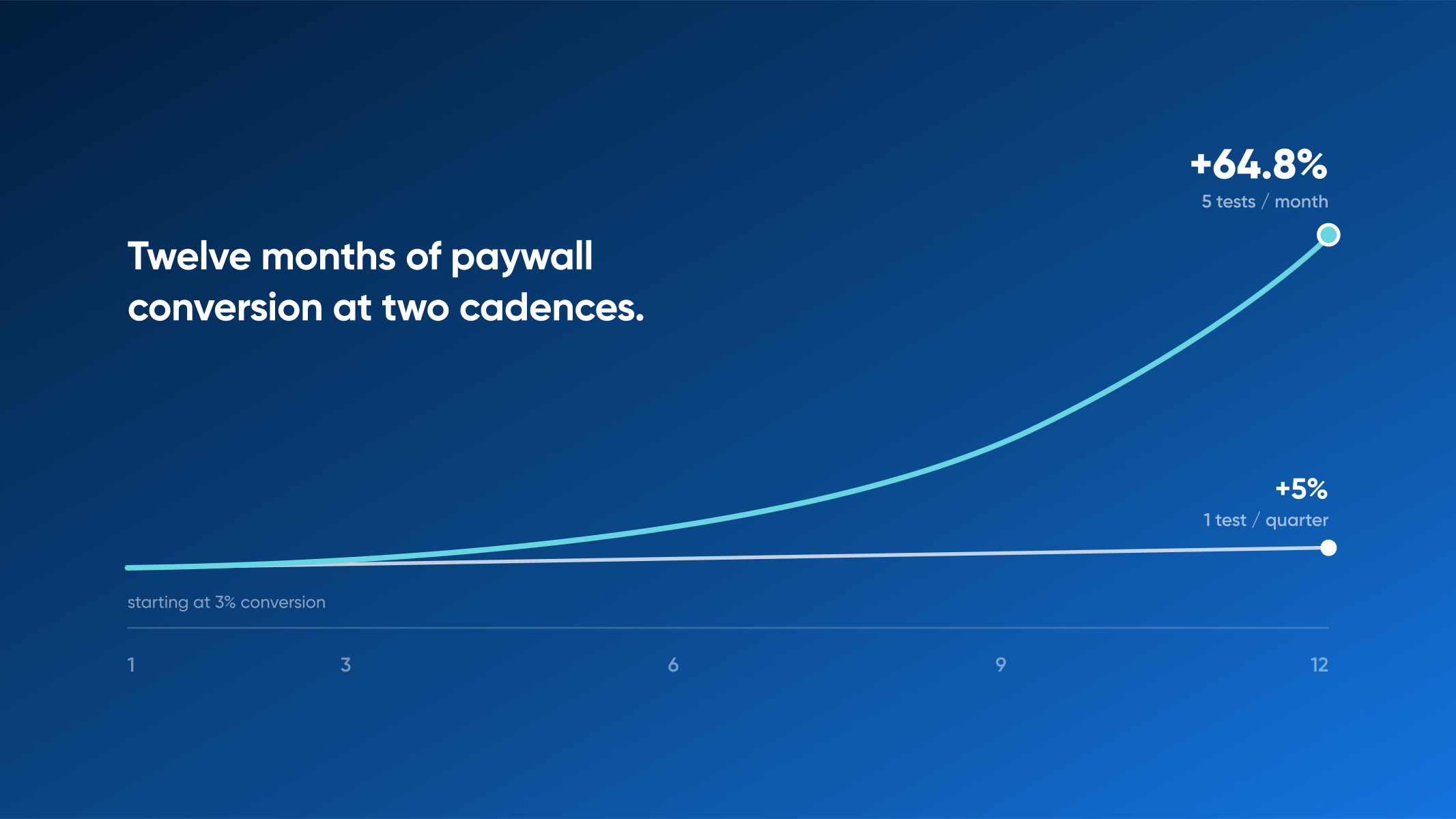
The point is what happens when you stack winners over time. A team running one experiment a quarter ships four tests in a year and gets roughly one winner. They’ve added a single-digit lift to their paywall conversion. A team running five experiments a month ships sixty tests in a year and stacks a dozen winners. Compounded over the year, that’s a step change in conversion. The first team is iterating; the second is compounding.
How testing velocity creates compounding wins
Why the paywall experiment velocity gap exists
Most subscription paywalls weren’t built to be tested. They were built to ship.
Inside the binary, the paywall is a screen. A screen is code. Code lives in a build. Builds go through QA, are submitted for review, and wait in a store queue. By the time a variant clears all of it, the hypothesis that started the cycle is six weeks old.
The experiment velocity gap is the distance between the experiments a subscription team would run if it could ship instantly and the experiments it actually runs given its release cycle. For most teams, that distance is where the compound revenue gets left on the table.
Engineering owns the experience layer by default. The paywall lives in code, so the team that ships changes to it is the engineering team, regardless of who wrote the hypothesis. That single fact reorders priorities. Paywall experiments compete with feature work, infrastructure work, and the rest of the product roadmap. The growth team is filing a request; the engineering team is allocating against everything else they owe.
Every variant is an app store release. Even a copy change requires a build, a submission, and a review window. Multiply that by the number of paywall variants a high-velocity team would run in a quarter and the math runs out of release slots before it runs out of ideas. The teams that A/B test paywalls without an app release have simply removed that queue from the loop: they update the paywall without an app store review.
Then there’s the hand-off itself. Growth writes the brief in an afternoon, then waits: a sprint, a build, a QA pass, a review queue, none of it theirs to control. The growth team is thinking:
"We want to test pricing, but it takes six weeks and an app store release."
"We know our paywall is losing us money, but we can’t touch it without a whole sprint."
This is a system that was designed for one cadence and is being asked to run at another. The engineering team didn’t build the gap. The structure around them did.
Experiment to launch timeline
What changes when you can A/B test paywalls without an app release
Moving paywall A/B testing out of code doesn’t change the practice. You still need a hypothesis, a control, a defensible sample size, and a metric you trust. What changes is the lead time, and what that lead time gives growth and product teams. The variant that used to take weeks ships in a day, and the decision to run it no longer waits on an engineering queue.
Creative decisions about subscriber experiences shouldn’t depend on engineering capacity, because the speed of those decisions is itself a competitive advantage. When paywall variants are pages composed in a visual editor instead of screens compiled into the app, they ship when they’re ready, not when the next release goes out. Experimentation stops relying on the engineering team’s calendar.
What high-velocity paywall experimentation looks like
The team running one paywall test a quarter is still arguing about which test to prioritize because each one matters too much. Every brief carries the weight of being the only experiment that quarter. Stakeholders weigh in. Designers iterate. The brief gets larger, slower, and less decisive as it ages. By the time the variant ships, the team has spent more energy choosing the test than running it.
The team running five tests a month doesn’t have that conversation anymore. They have a backlog and a calendar. They ship the smallest defensible test that produces a clean signal, read the result, and roll the next one. The wins compound. The losses are small. The cumulative learning rate is what subscribers actually feel when they hit the paywall.
The team running a hundred tests a month learns more about its subscribers in a quarter than the slow team learns in three years. The teams operating at that scale simply got the experiment out the door. High-velocity experimentation and hundreds of experiments in a window describe a way of working that a team grows into by shipping, not a feature it turns on.
Paywall conversion calculator
We set the Conservative scenario on the cautious side of what we see in practice. Even so, the gap between one experiment a quarter and five a month is wider than intuition suggests. And a hundred a month is twelve hundred shipped tests a year, an order of magnitude more than the team running five, which is why some paywalls have evolved beyond recognition while others are still showing the same screen they shipped in 2023.
Most subscription teams cannot get there without changing where the paywall lives. That’s the constraint to solve first.
Take an honest look at your paywalls
Count the paywall variants the team has actually shipped this year. That’s your real velocity, whatever the roadmap says. Match it against what the calculator above projects for your conversion outcome. The delta between what you’d do at velocity and what you’re doing now is the size of the leak.
Then pick the smallest paywall change with a measurable outcome and run it as a calibration experiment. You’re measuring the system, not the hypothesis: a real change forced through the real pipeline tells you the true lead time, not the estimate. If it takes a sprint and a release to ship a copy change, you’ve learned where the gap is and where to invest.
The test isn’t whether a change is important enough to justify a release. It’s whether it should need one. A paywall variant doesn’t. When the only thing standing between a hypothesis and a live test is an app store review, the release cycle has stopped being a safeguard and become a bottleneck. Move paywall experimentation to where the growth team can run it on its own cadence, without a ticket, and the count you started with stops being a ceiling.
The conversion problem is a velocity problem
The bottleneck has moved. Growth teams already know which paywall variants would help the business, which pricing structure to try, which audience deserves to try a different offer. They’ve known for two quarters. The variant has been on the list.
It hasn’t shipped because the system around it wasn’t built for the cadence the business is now asking of it. Paywall conversion isn’t a creative problem anymore. It’s a velocity problem. And velocity is what subscription orchestration, the experience layer treated as a designed system rather than a backlog, was built to give back.
The apps adding compound conversion are the ones whose tests are already in market.